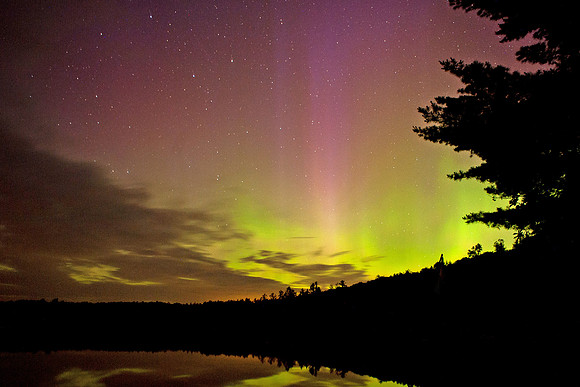
Fire in the Sky | During the summer solstice last Sunday, the sun endured a large explosion, causing an expanding cloud of electrified gases to be propelled forth from below its surface. Otherwise known as a coronal mass ejection (CME), the force of this explosion swept up two smaller CMEs that occurred earlier last week and created one of the largest geomagnetic solar storms in the last decade. Thanks to a darker waxing crescent moon, this created optimal viewing conditions for the aurora borealis throughout New England. Although conditions for the aurora can be very difficult to predict, the National Oceanic and Atmospheric Administration (NOAA) recently reported that these solar wind conditions may remain favorable for continued strong geomagnetic storming through Thursday night. On Tuesday, the NOAA advised Aurora watchers in the northern tier states of the US to stay alert for a possible repeat viewing. (Photo by Seth Butler / sethbutler.com)